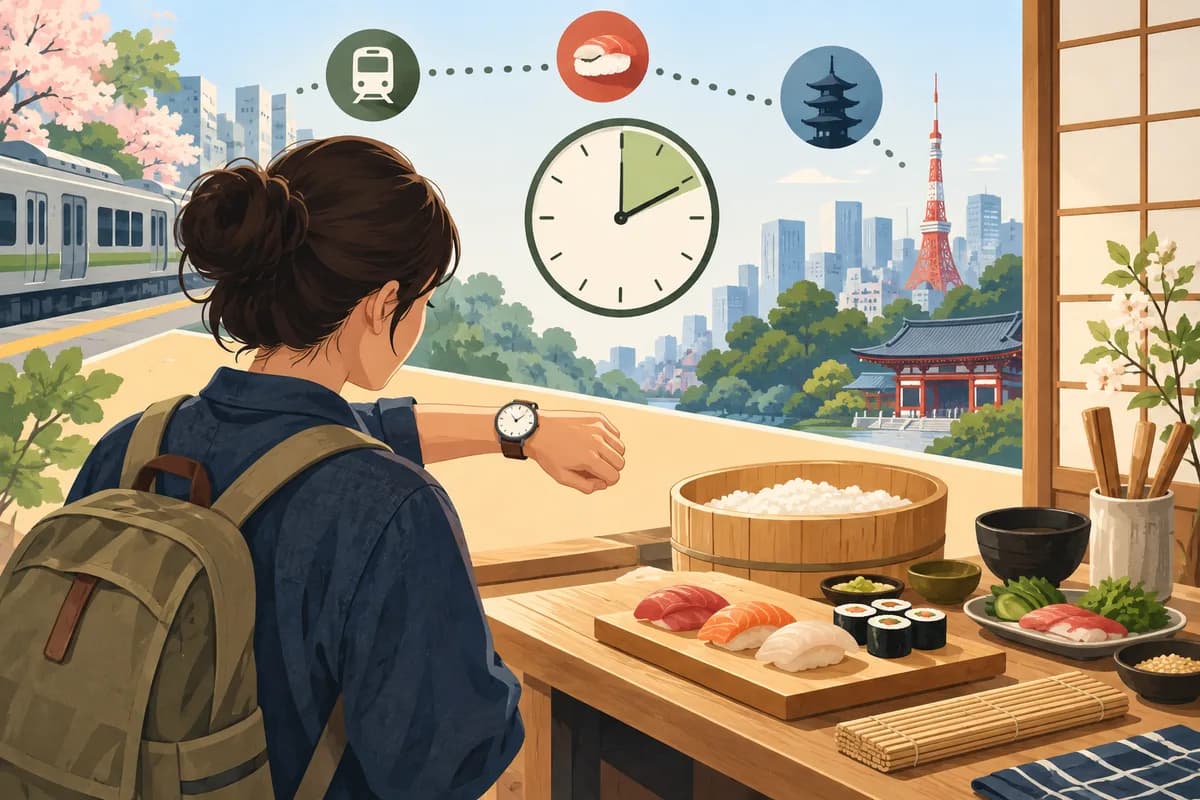
How Long Is a Sushi Class? Plan Your Day
"How long does a sushi class take?" sounds like a simple question, and for our signature class the answer is short: 90 minutes. The more useful question when planning a trip is how much of your day the class really occupies once you add getting there, arriving early and moving on afterwards. That block is always longer than the class itself.
This guide uses Sushi Matcha's signature sushi and matcha class in Asakusa as the example. It is a 90-minute session taught in English, in which you make nigiri and maki and whisk your own matcha. We do not list start times here, because the sessions offered can differ by date. Always check the class page for the date you have in mind.
Popular in Tokyo right now — our most recommended experience

Tokyo Sushi Making Class : Sake Ceremony & Matcha Experience in Asakusa
The class time versus the time block
Think of your class as the centre of a larger block rather than a single 90-minute entry in your calendar. That block has four parts:
- Travel to Asakusa. This depends entirely on where you are staying and how you travel. Check a route planner from your actual starting point on the day.
- Arriving early. The published guidance asks guests to arrive 10 minutes before the class starts.
- The class. The signature class lasts 90 minutes.
- Leaving and moving on. Gather your belongings, check your next route and allow some slack before anything with a fixed time.
Only the second and third parts are set by the class. The first and fourth are yours to estimate, and they are where most rushed itineraries go wrong.
Why the 10 minutes is not sightseeing time
It is tempting to count the early arrival as part of your buffer. It works better as its own fixed step. Those 10 minutes are there so you can settle in before the session begins, so using them for one more photo stop tends to make you late.
A practical habit is to plan to be near the studio a little before those 10 minutes start. If you get there early, Asakusa is an easy area in which to spend a few spare minutes. If your train is delayed, the extra margin protects your start.
Sample ways to arrange the day
These patterns are not schedules we operate. They show how to think about the time around a 90-minute class. Use the confirmed start time from your own booking in place of the steps below.
A class with a relaxed start
- Leave your accommodation with enough travel time plus a margin.
- Arrive 10 minutes before the class.
- Take the 90-minute class.
- Keep the next hour flexible for a nearby walk, a rest or a café, rather than booking another timed activity immediately.
This suits travellers who want one clear highlight and do not want to watch the clock.
A class between two sightseeing blocks
- Spend the earlier part of the day on sights you can leave whenever you like.
- Head to the studio with a buffer, rather than leaving the last sight at the final possible minute.
- After the class, choose places without a fixed entry time.
Open-ended plans before and after make it easier to absorb a delay without losing the class.
Arriving in Tokyo on the same day
If you are coming straight from an airport or a long-distance train, allow a larger margin than usual, because arrival times and queues can vary. If you will have bags with you, read our guide to taking a sushi class before hotel check-in before you settle your plan.
Planning around weather and energy
A 90-minute indoor activity can anchor a day when the weather is uncertain. Rain slows walking and makes changing plans more tiring, so the travel margins above matter even more. Our rainy-day Asakusa plan shows how to keep the rest of a wet day flexible around a class.
Energy matters too. A class means 90 minutes of concentrating on a new skill and following instructions. For some people that is relaxing; for others it is a good reason to schedule something low-key afterwards. If you are travelling with people who tire quickly, consider putting the class earlier in the day rather than at the end of a long walking itinerary.
Common timing mistakes
- Treating 90 minutes as the whole commitment. Add travel, the 10-minute early arrival and time to move on.
- Booking a timed activity straight afterwards. Leave a gap, especially if the next place is in another part of Tokyo.
- Relying on an older description. General write-ups about cooking classes sometimes mention longer formats. Check the current class page instead.
- Assuming a start time. Sessions can differ by date, so use the time shown for your booking rather than an example itinerary.
- Forgetting language needs. The signature class is taught in English. If someone in your group needs support in another language, plan for that before the day.
A quick worksheet
Before booking, write down:
- The date and the class start time shown for it.
- Your travel time from wherever you will be beforehand, plus a margin.
- Your arrival time: 10 minutes before the start.
- The finish: 90 minutes after the start.
- Your next fixed commitment, and how far away it is.
If line 5 leaves no room after the finish, move one of the two rather than hoping everything runs to the minute. This short exercise often shows whether a day is comfortable or overloaded before you have paid for anything.
Fit the class into your trip
Once you know the block of time you need, choosing a date becomes simpler. Open the signature sushi and matcha class page, check the sessions currently offered for your party and confirm the start time before arranging the rest of your day around it.
Related Articles
Rainy-Day Asakusa: A Sushi Class Plan
Build an Asakusa rainy-day plan around an indoor sushi and matcha class, with realistic travel time, flexible sightseeing and clear booking conditions.
Sushi Class Before Hotel Check-in
Have luggage before hotel check-in? Plan an Asakusa sushi class around studio storage, the right station exit and a confirmed reservation.

Book a Sushi Class Early or on the Day?
Reserve a Tokyo sushi class in advance or try on the day? Weigh certainty against flexibility and know what to check before counting on a same-day place.