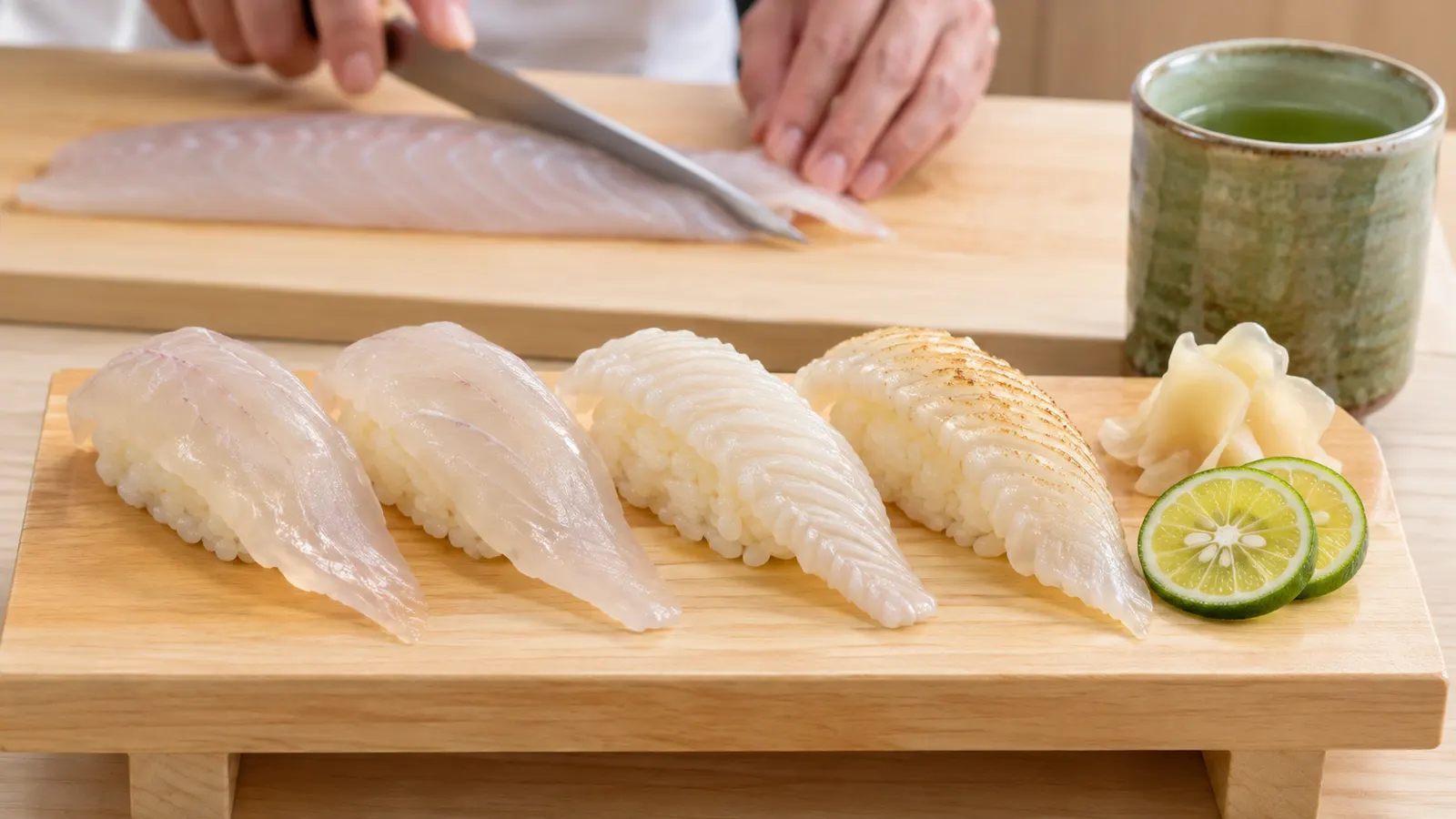
Hirame vs Karei: Flounder Sushi and Engawa
On a winter sushi menu in Japan you may see hirame, karei and engawa listed separately, all translated as "flounder" or "halibut". They are related but not the same. Hirame is the olive flounder, a premium white fish at its best in winter. Karei is a group of many flatfish species, several of which are prized in summer. Engawa is not a fish at all but a particular cut: the strip of muscle along the fins.
This guide explains how to tell them apart, when each is in season and how to order them at the counter.
Popular in Tokyo right now — our most recommended experience
Tokyo Sushi Making Class : Sake Ceremony & Matcha Experience in Asakusa
The short answer
- Hirame (olive flounder): clean, delicate white flesh, at its best in winter. Usually sliced thin.
- Karei (righteye flounders): a family of species. For raw sushi, the prized ones such as makogarei are best in early summer and summer.
- Engawa: the fin muscle of hirame or karei. Richer and chewier than the main fillet, and often served seared.
Left hirame, right karei
Both are flatfish that lie on the seabed with both eyes on one side of the head. Japanese cooks remember the difference with the saying hidari hirame ni migi karei, "left hirame, right karei". Japan's agriculture ministry explains it this way: place the fish eyes up with its belly towards you, and a karei's head points to the right, while a hirame's points to the left.
There are exceptions. The fish encyclopedia Zukan Bouz notes that the starry flounder (numagarei), which is called a karei, has its eyes on the left. In Japanese waters almost all of them do. So the saying is a handy guide at the fish counter, not a rule of biology. Hirame also has a noticeably large mouth.
Hirame: the winter white fish
Zukan Bouz describes hirame as a premium white fish across Japan. Large fish are at their best in autumn and winter, and the Tokyo central wholesale market lists hirame among its winter seafood. Ibaraki Prefecture describes December to February as the season for kan-birame, "cold-season hirame", when the flesh thickens and gains fat.
Hirame was once mostly a fish for sushi counters and high-end restaurants. Today farmed hirame is common too. According to the national fisheries cooperative federation, Oita Prefecture is Japan's largest producer of farmed hirame, with about 20% of the national total. Imports also reach supermarkets.
Because the flesh is lean and firm, sushi chefs usually cut hirame thinly at an angle, a cut the agriculture ministry recommends for thinner fish such as sea bream and hirame. Another classic preparation is kobujime: the fillet is wrapped in kelp for some hours, which adds savoury depth to its mild taste.
Karei: a summer favourite
"Karei" covers many species. The agriculture ministry lists magarei, makogarei, asabagarei and akagarei as the main ones on the market.
For raw fish, two names are worth knowing:
- Makogarei (marbled flounder): Zukan Bouz describes it as a premium fish for sashimi, at its best from about May to September depending on the region. A well-known local name is Shiroshita-karei, for makogarei caught below the old castle at Hiji in Oita Prefecture.
- Hoshigarei (spotted halibut): often more expensive than wild hirame. Its season is early summer to summer, and quite a few sushi chefs rank it as the finest white fish.
Zukan Bouz sums up the general feeling at sushi counters: among raw white fish, hirame is a winter fish and karei a summer one.
What engawa is
Engawa is the muscle attached to the small bones at the base of the dorsal and anal fins. The name comes from the engawa, the narrow veranda that runs along the edge of a traditional Japanese house. According to the seafood company Umios (formerly Maruha Nichiro), one fish gives only four strips, which is why some sushi shops serve it only to regulars.
The texture is distinctive: crunchy and chewy, with more fat than the main fillet. Hirame engawa is firmer and less fatty, with a delicate sweetness. Karei engawa is softer and richer. Engawa is also a popular piece to sear, which softens it and brings out the fat. Our guide to aburi, seared sushi, explains the technique.
Engawa at conveyor-belt sushi
At conveyor-belt chains, engawa is usually not from hirame. Umios explains that the engawa used by conveyor-belt chains and supermarket packed sushi is mainly from larger karei, such as Greenland halibut (karasugarei), Kamchatka flounder (aburagarei) and Pacific halibut (ohyo). Hama Sushi's published list of origins, for example, gives engawa as karei from the USA, Canada, Iceland, Denmark, Norway and Russia.
That is not a trick: it is a different, affordable product with its own rich taste. If you want hirame engawa, ask at a counter restaurant, and expect only a little of it.
Is raw hirame safe?
Japan's health ministry notes one specific issue with raw hirame: a parasite called Kudoa septempunctata. It can cause brief vomiting or diarrhoea a few hours after eating, and symptoms are usually mild. Japan sets a legal limit for it in hirame sold for raw eating, and the ministry explains that the agriculture and fisheries authorities control it through management at fish farms, which has reduced cases. Freezing at −20°C for four hours or more, or heating it thoroughly, stops it from causing illness. For a wider look at raw seafood in Japan, see our guide to whether raw fish is safe in Japan.
How to order
| Hirame | Karei | Engawa | |
|---|---|---|---|
| What it is | Olive flounder | Many righteye flounders | Fin muscle |
| Best season for sushi | Winter | Early summer to summer (makogarei, hoshigarei) | Follows the fish |
| Taste | Clean, delicate | Varies by species | Rich, chewy |
| Often served | Thin slices, kobujime | Thin slices | Plain or seared |
In winter, start with hirame and ask whether they have engawa. In Japanese, "Hirame to engawa, hitotsu zutsu" means "One each of hirame and engawa". In summer, ask which karei they have that day. For more winter choices, see our guide to winter sushi fish in Tokyo, and for another pair that confuses visitors, our guide to ika and tako.
Making nigiri yourself
White fish such as hirame shows how much technique matters: a thin slice has to sit neatly on the rice and hold together. That is the kind of skill you practise in our signature sushi and matcha class in Asakusa, where an English-speaking instructor shows you how to shape nigiri and roll maki in 90 minutes. Toppings depend on the season and availability, so we cannot promise hirame or engawa on a particular date. If you have a fish allergy, list it when you book and wait for a reply before relying on it.
When you want to shape your own nigiri, book a class.
Related Articles
Hotate, Akagai, Hokkigai: Shellfish Sushi
Scallop, ark shell and surf clam are the shellfish you meet most at sushi counters in Japan. How they differ, when they are best and what to say on allergies.
Nikiri, Tsume and Soy Sauce on Sushi
Why sushi chefs brush sauce on nigiri: nikiri, the sweet tsume on anago, the main types of Japanese soy sauce and when to skip the dipping dish.
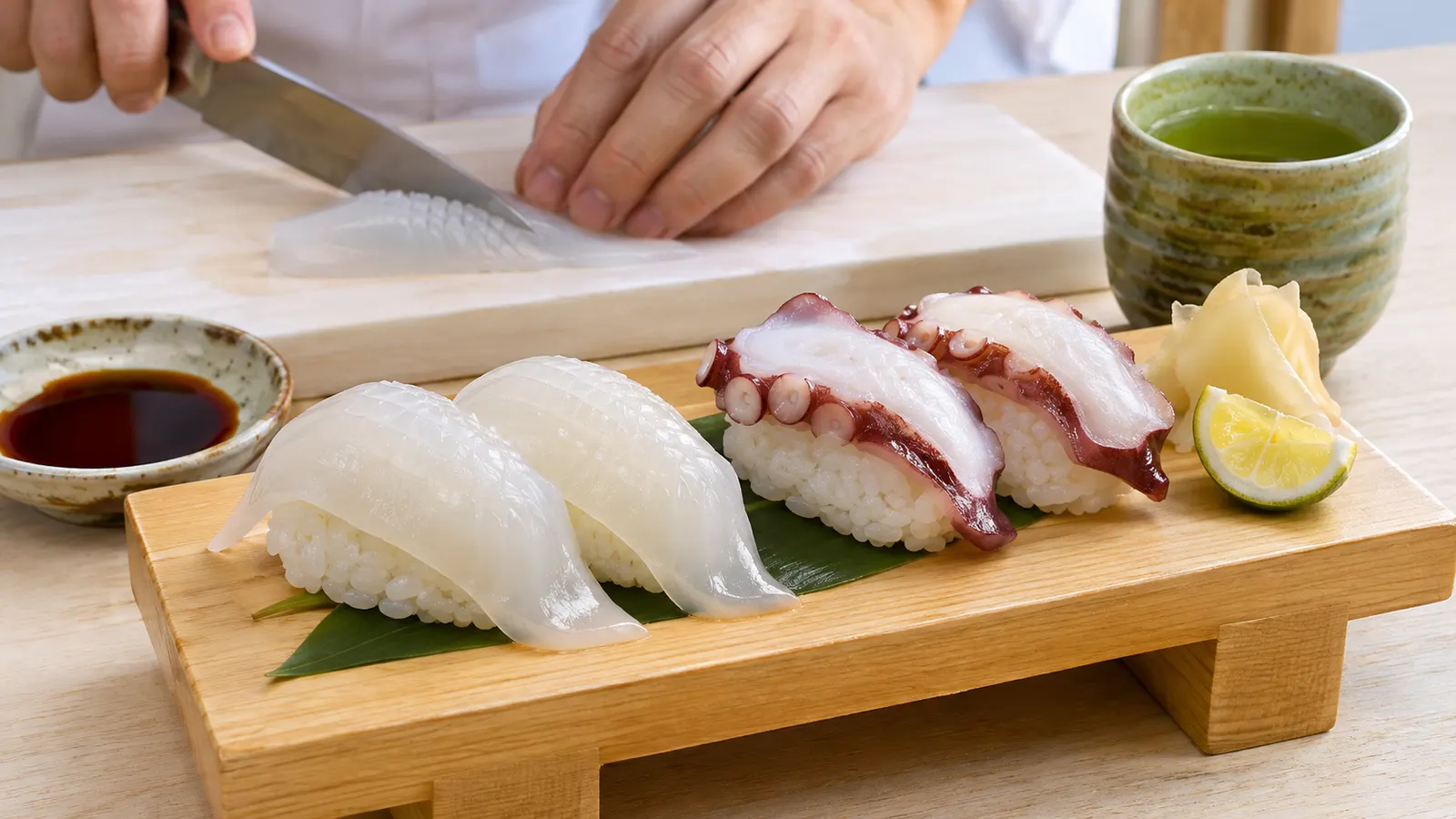
Ika vs Tako: Squid and Octopus Sushi
Ika is squid, usually served raw; tako is octopus, usually boiled. How the two nigiri differ, the main types and seasons, and how to order.