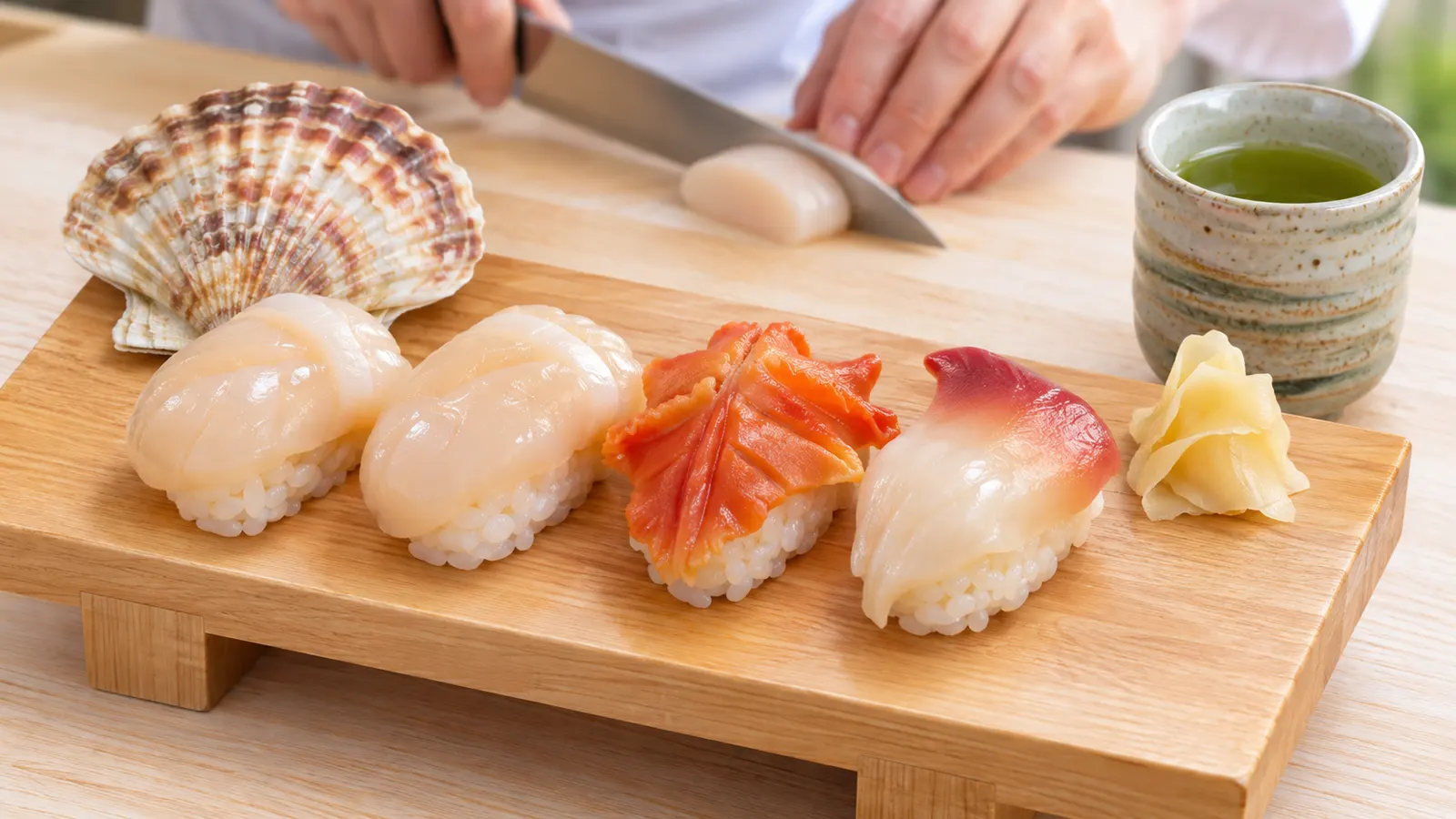
Hotate, Akagai, Hokkigai: Shellfish Sushi
Look at the board in a Japanese sushi restaurant and you will often find a group of names ending in -gai, the word for shellfish: hotate, akagai, hokkigai, torigai. Menus in English tend to call them all "clam" or "scallop", which hides how different they are. One is soft and sweet, one is bright red and crunchy, and one turns pink only after it meets hot water.
This guide covers the three you are most likely to see, a few others worth knowing, and what to say if you have a shellfish allergy.
Popular in Tokyo right now — our most recommended experience
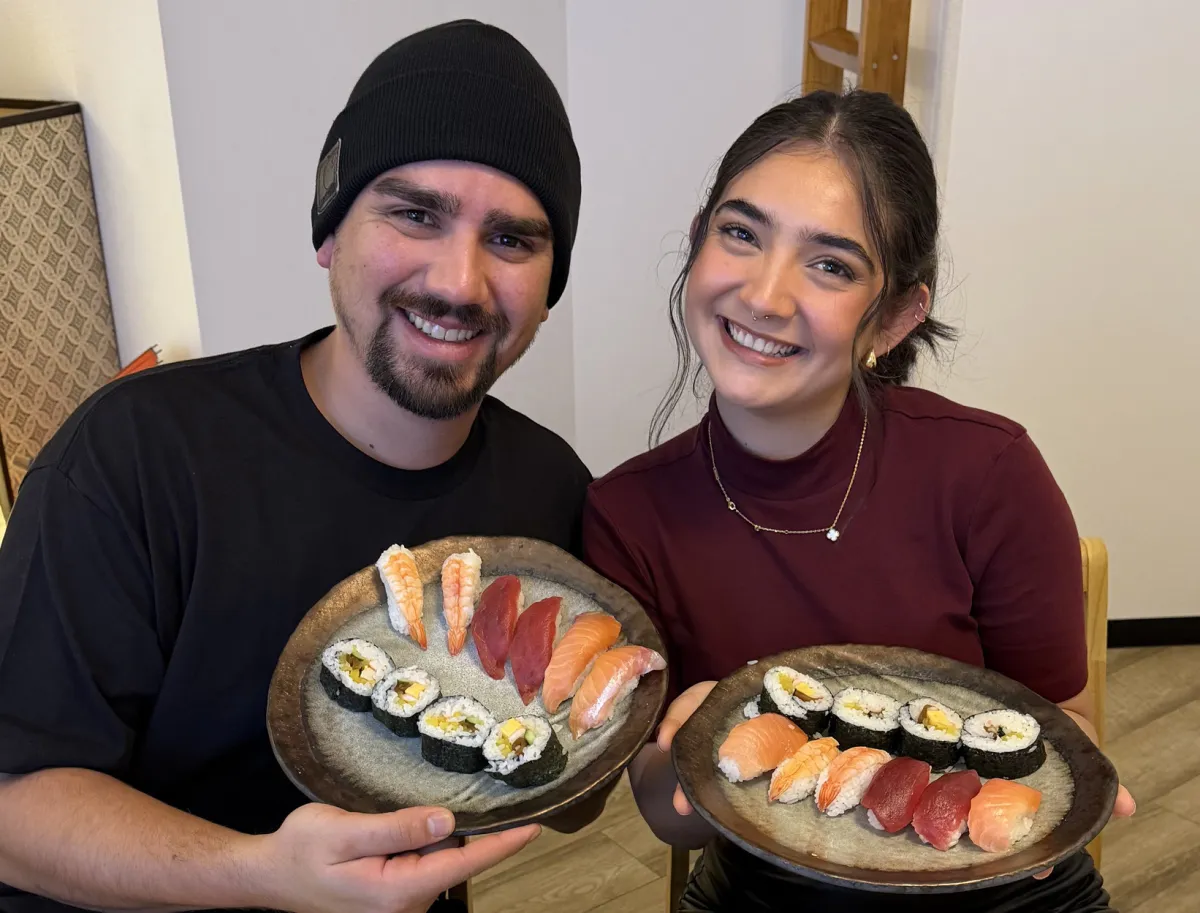
Tokyo Sushi Making Class : Sake Ceremony & Matcha Experience in Asakusa
The short answer
- Hotate (scallop): the thick, white adductor muscle. Soft, very sweet, usually served raw or lightly seared.
- Akagai (ark shell): a red-fleshed clam with a crisp bite and a sea aroma. A classic Edomae topping.
- Hokkigai (surf clam): a large clam from northern Japan. The tip turns red when blanched, which is how it is usually served.
Hotate: the sweet one
The Japanese scallop (Mizuhopecten yessoensis) is the shellfish most visitors already know. For sushi, chefs use the round adductor muscle, the part that opens and closes the shell. The fish encyclopedia Zukan Bouz describes the raw muscle as notably sweet and gives late autumn to early summer as its best season.
Japan produces a lot of it. According to a fisheries promotion foundation, national output is around 500,000 tonnes a year. Part of it is wild-grown on the seabed off Hokkaido's Okhotsk coast after young scallops are released there. The rest is raised hanging from ropes in the sea, mostly in Hokkaido and in Mutsu Bay, Aomori.
At the counter, hotate comes raw on the rice or seared with a torch so the surface browns. Our guide to aburi, seared sushi explains the technique. The frilly mantle around the muscle, called himo, is also eaten, often as a side dish rather than as nigiri.
Akagai: the red one
Akagai (Anadara broughtonii) means "red shellfish", and the colour is real. Zukan Bouz explains that its blood contains haemoglobin, the same red pigment as ours, which is unusual for a shellfish. The flesh is orange-red, firm and slightly crunchy, with a fresh sea smell.
It is one of the traditional toppings of Edomae sushi, the Tokyo style, and was once plentiful in Tokyo Bay. Today, domestic akagai comes mainly from places such as Yuriage in Natori, Miyagi Prefecture, as well as western Japan, and imports from Korea and China make up a large share of the market. Zukan Bouz gives autumn to spring as the season, with the flavour falling off in late spring before spawning.
Preparation is part of the show. The chef opens the foot, removes the innards, scores it and then slaps it on the board so the flesh tightens and opens up. The scoring also gives each piece its pattern. The himo, the edge of the mantle, is cut away and served separately.
Hokkigai: the one that turns pink
Hokkigai is the common name for the Sakhalin surf clam, a large clam from cold northern waters. Tomakomai in Hokkaido has the largest catch of any municipality in Japan, at about 15% of the national total. The city notes that only clams of 9 cm or more are shipped, and that fishing pauses in May and June for spawning.
Raw hokkigai is brownish or darker. Zukan Bouz notes that it turns red when heated and becomes sweeter, so for sushi the foot is usually opened, blanched briefly and cooled in iced water. That is why the nigiri has a pink-red tip. Some chefs serve it raw instead for a stronger shellfish flavour, so the colour on your plate tells you which way it was prepared.
Three more you may see
- Torigai (Japanese cockle): a dark foot whose black colour rubs off easily. It is blanched rather than served fully raw, which brings out its sweetness.
- Aoyagi and kobashira: aoyagi is the market name for the bakagai clam, and kobashira are its small adductor muscles. Zukan Bouz gives roughly February to July as its best time.
- Mirugai: a large clam prized for its long siphon, which is why it is expensive. A cheaper relative is sold as shiro-miru.
Side by side
| Hotate | Akagai | Hokkigai | |
|---|---|---|---|
| Part used | Adductor muscle | Foot | Foot |
| Usually served | Raw or seared | Raw, scored | Blanched, sometimes raw |
| Texture | Soft, creamy | Crisp, springy | Chewy, firm |
| Taste | Very sweet | Fresh sea aroma | Sweeter after blanching |
| Main domestic source | Hokkaido, Aomori | Miyagi, western Japan | Hokkaido |
If you are new to shellfish, start with hotate. If you enjoy firm textures, try akagai next. In Japanese, "Hotate to akagai, hitotsu zutsu" means "One each of scallop and ark shell".
Shellfish allergies and labels
Shrimp and crab are crustaceans. Scallops and clams are molluscs. They are different groups, and only a doctor can tell you which ones are safe for you. Japan's food labelling rules treat them differently: shrimp and crab are among the ingredients that must be declared on packaged food, while among molluscs only abalone and squid are on the recommended list, and scallops and clams are on neither. So a label without a warning does not mean "no shellfish".
At a restaurant, name the exact foods: "scallop and clam" or "all shellfish", not just "seafood". Shared boards and knives can matter if the allergy is severe. Our guide to ebi and amaebi covers the crustacean side.
There is also a general food safety point. Japan's health ministry explains that bivalves filter large amounts of seawater and can concentrate norovirus, which is why it recommends cooking them thoroughly. Japan has legal controls and monitoring for shellfish toxins, including in scallops. If you are pregnant or have a weak immune system, ask your doctor about raw shellfish. Our guide to whether raw fish is safe in Japan covers the wider picture.
Shellfish in our sushi class
The nigiri toppings listed on our sushi making class page are lean tuna, medium-fatty tuna, salmon and prepared shrimp, plus a thick futomaki roll. Scallop and clams are not part of the standard menu, so this guide is for ordering in restaurants rather than a preview of the class.
If you have a shellfish allergy, our FAQ lists shellfish-free options among the common accommodations. Write every allergy in your booking and wait for an individual reply before relying on it. Our guide to food allergies at a sushi class explains what to include. The signature sushi and matcha class in Asakusa lasts about 90 minutes, with nigiri and maki, a sake toast, a meal of what you make and a bowl of matcha you whisk yourself.
Once you have shaped a few pieces of nigiri, you will look at that row of shellfish at the counter differently. Book a class and learn the basics in English.
Related Articles
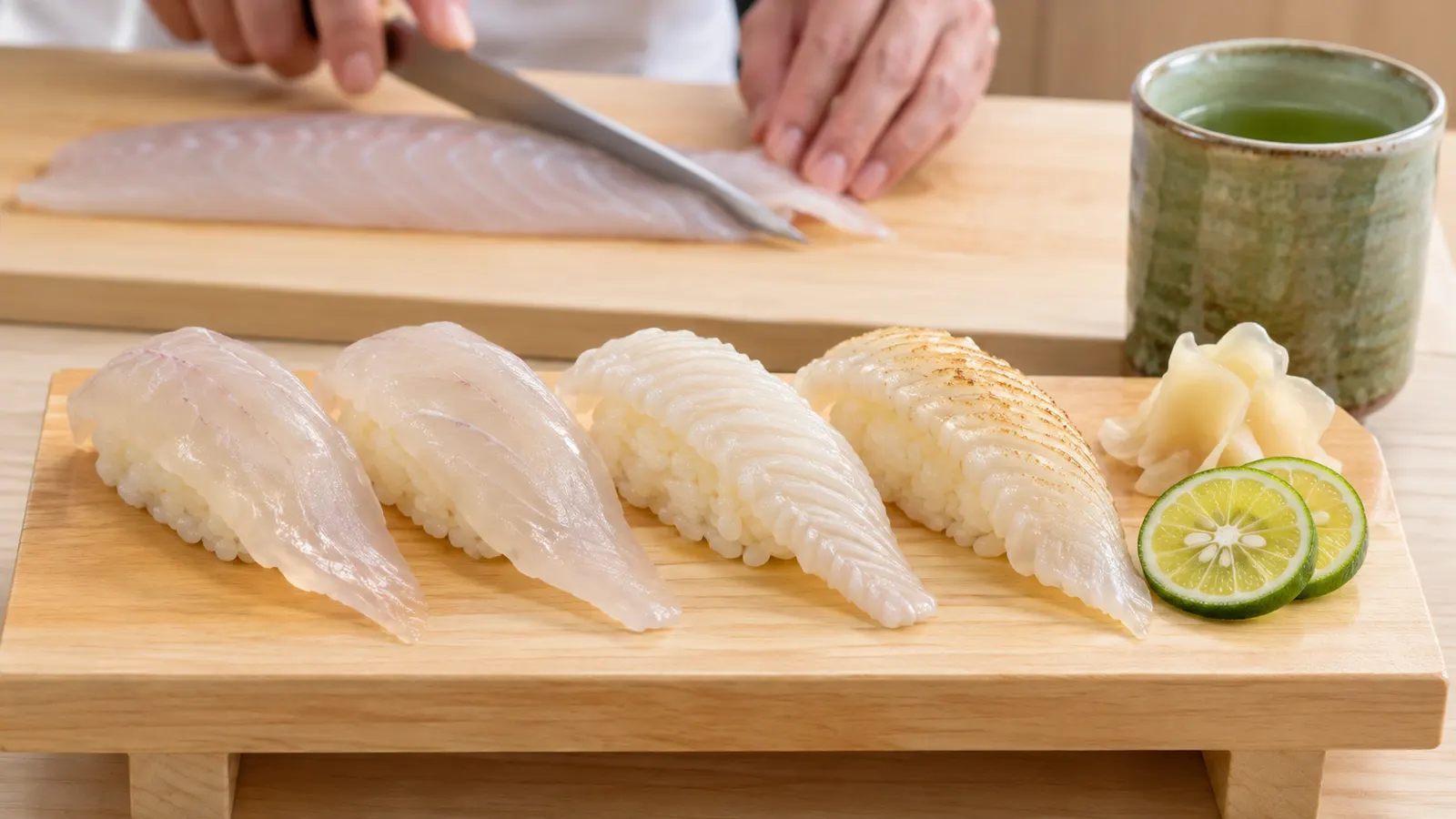
Hirame vs Karei: Flounder Sushi and Engawa
Hirame and karei are both flounder, but they differ in season, taste and price. How to tell them apart, what engawa is and how to order.
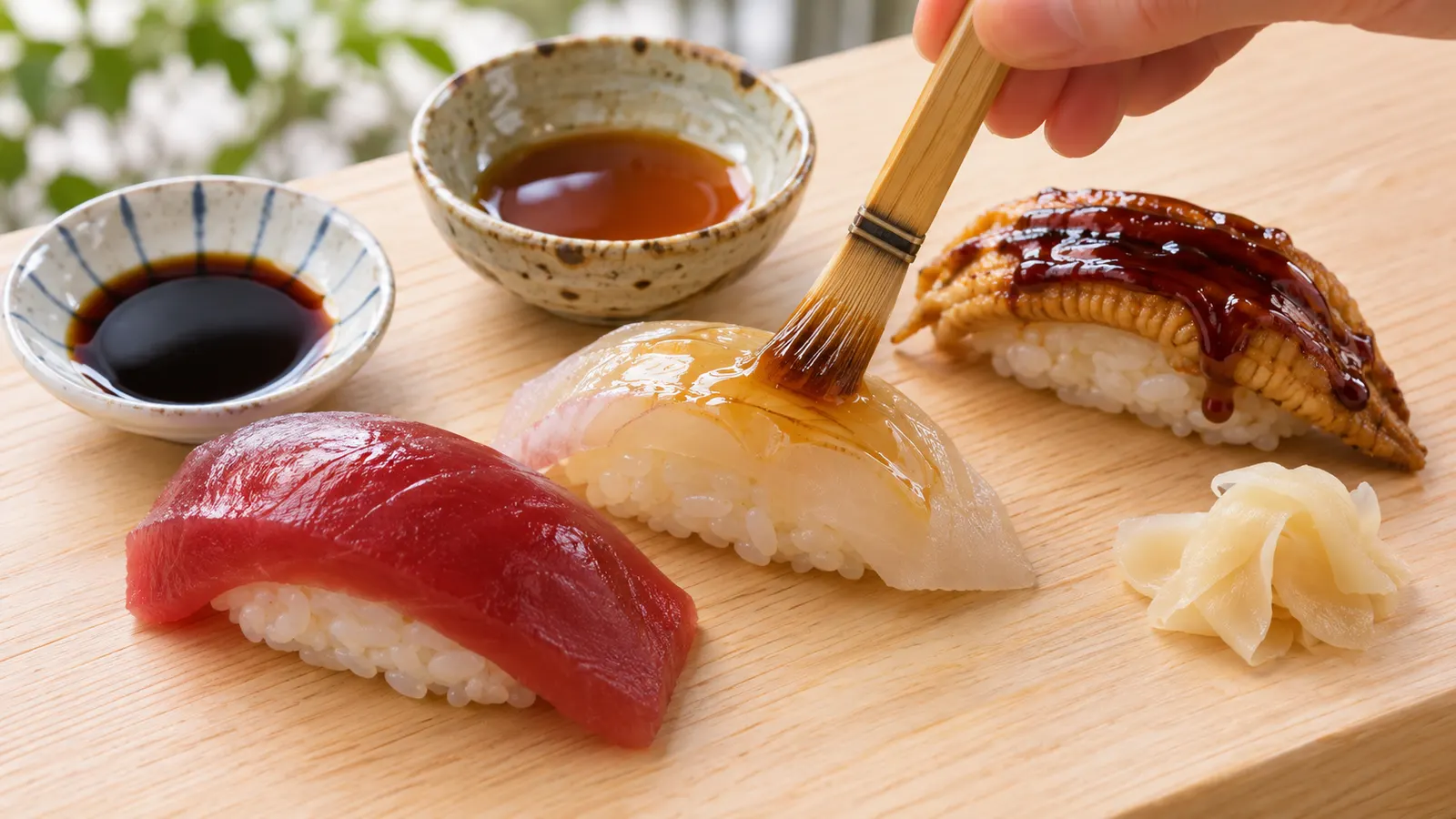
Nikiri, Tsume and Soy Sauce on Sushi
Why sushi chefs brush sauce on nigiri: nikiri, the sweet tsume on anago, the main types of Japanese soy sauce and when to skip the dipping dish.
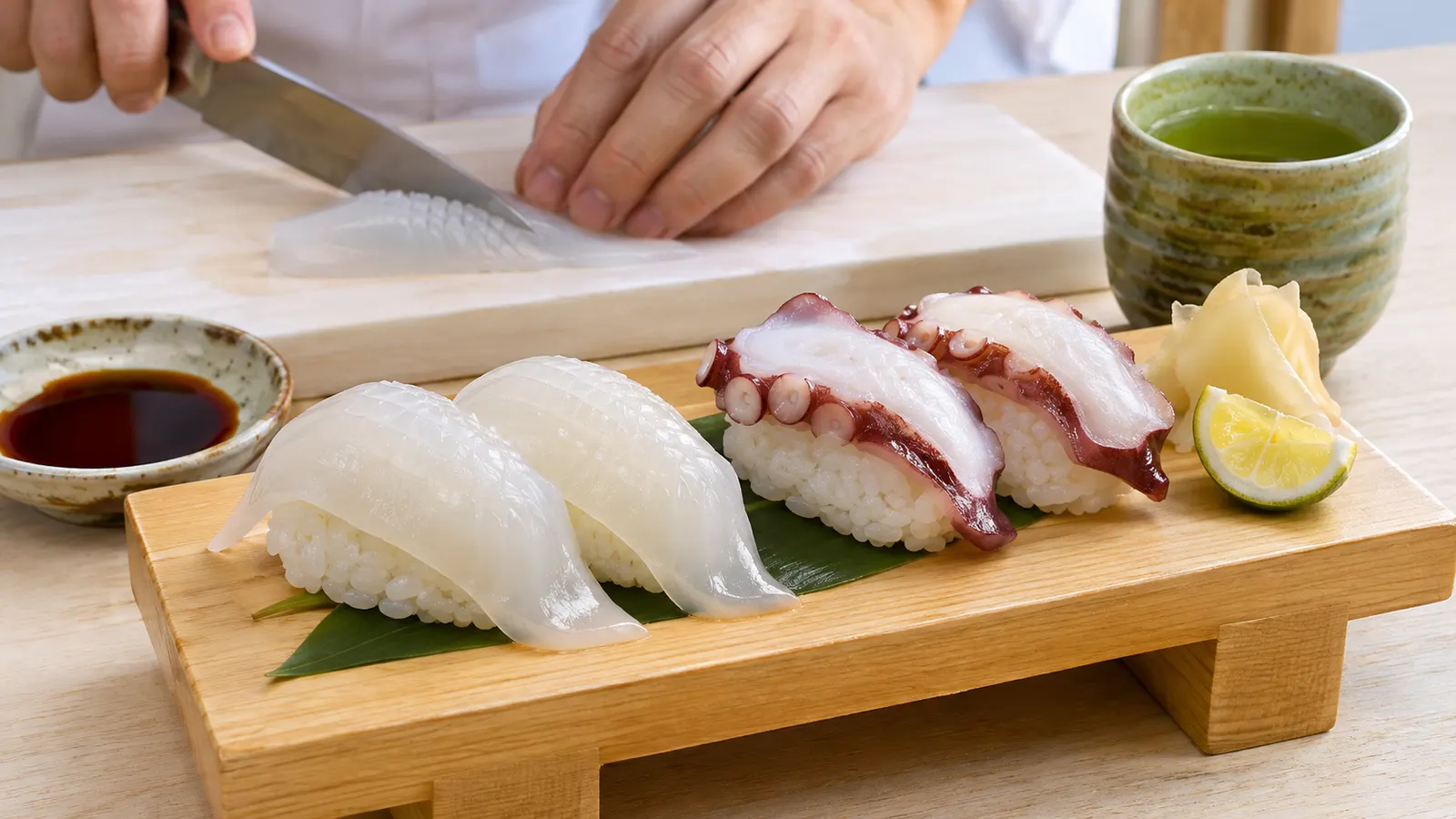
Ika vs Tako: Squid and Octopus Sushi
Ika is squid, usually served raw; tako is octopus, usually boiled. How the two nigiri differ, the main types and seasons, and how to order.